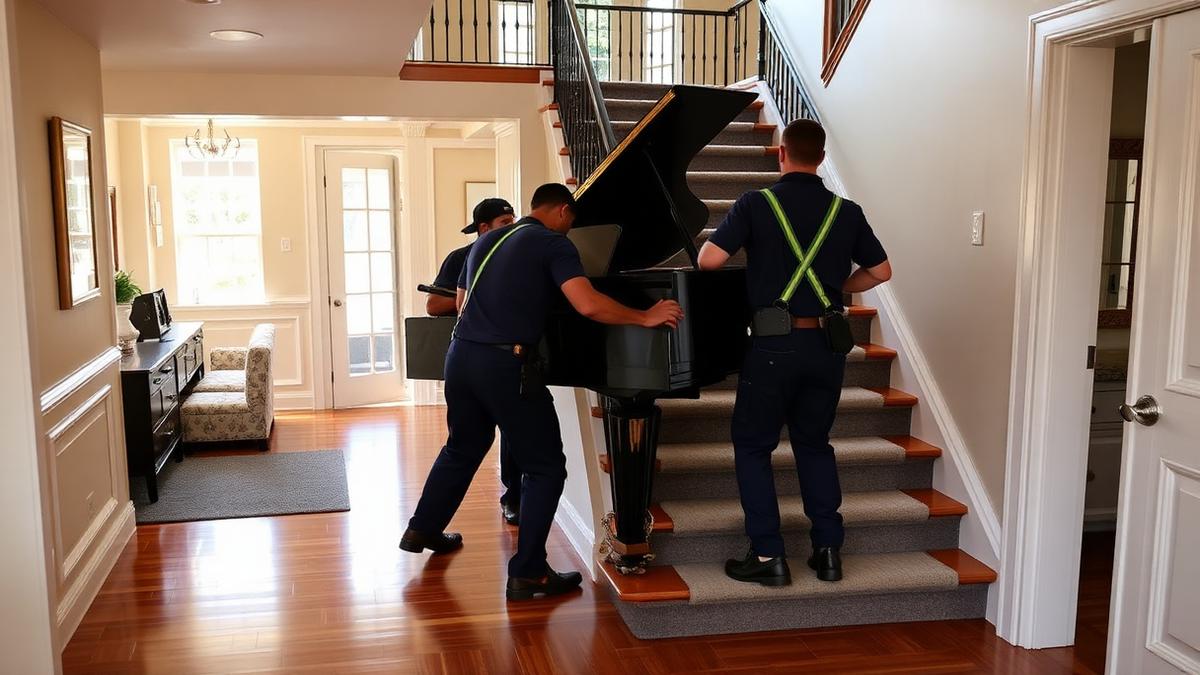
A piano is one of the heaviest, most awkward, and most valuable things in your home — and most moving damage happens because the crew wasn’t trained to handle it. Whether you own a spinet, an upright, a baby grand, or a full concert grand, moving it safely requires equipment, technique, and experience that standard movers don’t have. Learn more about our piano moving services or get a quote from our Dallas team.
Why Pianos Are So Hard to Move
It’s not just the weight — though that’s significant. A standard upright weighs 300–500 lbs. A baby grand runs 500–600 lbs. A full grand can exceed 1,200 lbs. But weight is only part of the challenge:
- Uneven weight distribution — Grand pianos are heavier on the bass side. Tilting wrong can damage the soundboard or legs
- Fragile internal components — Hammers, strings, and the pin block are precision instruments. Vibration and impact cause tuning instability and mechanical damage
- Exterior finish — High-gloss lacquer scratches permanently. One belt buckle or zipper can leave a mark you can’t buff out
- Floor and wall risk — A piano on casters can gouge hardwood. A piano in a doorway can crack trim, dent drywall, or strip paint
Upright vs. Grand: What’s Different About Moving Each
| Factor | Upright Piano | Grand Piano |
|---|---|---|
| Weight | 300–500 lbs | 500–1,200+ lbs |
| Crew Size | 2–3 movers | 3–4 movers minimum |
| Disassembly | Usually none needed | Legs and pedal lyre removed |
| Transport Position | Upright on dolly | On its side on a piano board |
| Stairs | Difficult but manageable | Requires specialized stair equipment |
| Price | Quoted, not published | Quoted, not published |
Stairs, Elevators, and Tight Corners
Where the piano lives in your home matters as much as the piano itself. Here’s what changes the complexity:
- Ground floor, wide doorways — Straightforward. Piano dolly rolls out, onto the ramp, into the truck. Minimal risk
- Stairs (up or down) — Each flight adds significant time, labor, and cost. A grand piano going down a curved staircase requires a full crew with straps and a stair board
- Elevators — Most high-rise buildings in Dallas have freight elevators that fit an upright piano. Grand pianos are tighter — we measure in advance
- Tight turns and narrow hallways — Common in older Highland Park and University Park homes. May require removing doors from hinges or tipping the piano to clear
What to Do Before Piano Moving Day
Preparation prevents problems. Here’s your checklist:
- Measure everything — Doorways, hallways, stairwell widths, and elevator dimensions at both locations. Share photos with your mover in advance
- Close the lid and lock it — If your piano has a key lock, use it. If not, your movers will tape or strap it closed
- Clear the path — Remove rugs, shoes, and furniture from the route between the piano and the front door
- Protect the floors — Your moving company should lay down hardwood runners and carpet shields. If they don’t offer this, that’s a red flag
- Plan for retuning — Every piano needs to be tuned after a move. Schedule your tuner for 2–3 weeks after the move to let the instrument acclimate to its new environment
How Much Does Piano Moving Cost in Dallas?
Stonebriar does not publish piano prices. The quote depends on the piano, the access at both addresses, and the distance. Stairs, a freight elevator, and a long-distance trip each change the job. The estimate is free. Call (972) 670-5889.
- Upright, ground floor to ground floor — usually the simplest local piano move
- Baby grand, ground floor — legs and the pedal lyre come off before it goes on the board
- Grand piano with stairs — more crew and a stair board. The number of flights matters
- High-rise elevator move — COI, elevator reservation, and the loading dock are part of the quote
- Long-distance — quoted from the piano and the route, not from a per-mile card
What to Ask Before Hiring a Piano Mover
Not every moving company can move a piano safely. Here are the questions that separate professionals from amateurs:
- “Do you have a piano board?” — A piano board (or skid board) is essential for moving grands. If they don’t have one, they’re not piano movers
- “How many crew members for my piano type?” — An upright needs 2–3. A grand needs 3–4. If they say “two guys can handle it,” walk away
- “Are you insured for specialty items?” — Standard mover liability ($0.60/lb) means your $50,000 Steinway is covered for about $400. Ask about full-value coverage
- “Have you moved pianos in my building before?” — For Turtle Creek and Uptown high-rises, building familiarity prevents logistical disasters
- “Will you protect my floors?” — The answer should be “always” — not “if you want”
Common Piano Moving Mistakes
- DIY with friends — This is how pianos fall down stairs, floors get gouged, and backs get thrown out. A piano dolly from Home Depot is not professional equipment
- Hiring the cheapest mover — A grand-piano quote that sounds too small usually means the crew does not have a piano board
- Not measuring in advance — A grand that cannot clear the door on arrival is a second trip. Measure before the truck leaves
- Skipping the post-move tuning — Temperature and humidity changes during the move will shift the tuning. Budget for a tuning 2–3 weeks after
The Bottom Line
Your piano is one of the most valuable and emotionally significant items in your home. Moving it safely requires a crew that’s done it hundreds of times — with the right equipment, the right insurance, and the right attitude. Don’t gamble on the cheapest option. Get it moved once, get it moved right.
Related Reading
Piano Movers Dallas
Our piano moving service page
White Glove Moving Dallas
Full-service premium moves
What Is White Glove Moving?
How white glove differs from standard
How to Pack for a Move
Room-by-room packing guide