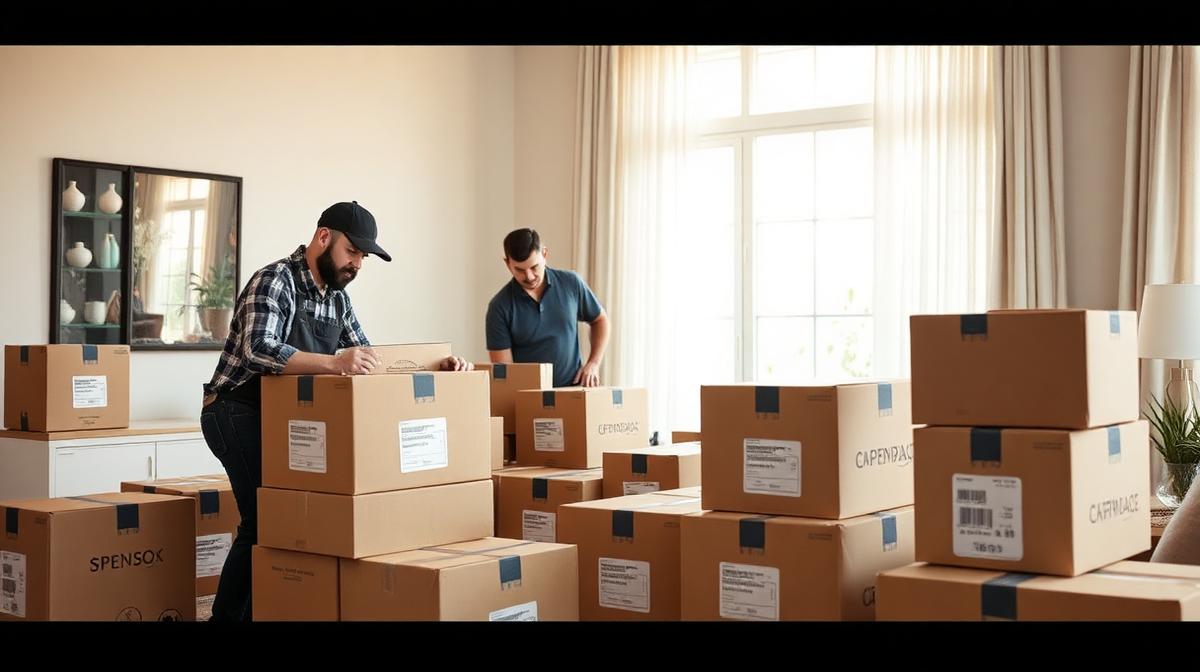
Packing is where most moves fall apart. If you need help, consider professional packing services from a trusted professional relocation services in Dallas. Not the driving. Not the heavy lifting. The packing. Boxes that aren’t labeled. Fragile items wrapped in newspaper. An entire kitchen stuffed into three oversized boxes that weigh 80 pounds each.
Whether you’re packing yourself or considering professional packing services, here’s the room-by-room system we use on every move.
Start With What You Don’t Use
Begin packing 2–3 weeks before your move date. Start with the rooms and items you use least: guest bedrooms, storage closets, seasonal clothing, books, and decorative items. This gives you momentum without disrupting your daily routine.
Leave your kitchen, bathroom essentials, and daily-use items for the last 48 hours. You’ll need them until the end.
The Kitchen — Hardest Room in the House
The kitchen is where most DIY packing goes wrong. Here’s how to do it right:
- Dishes and glassware: Wrap each piece individually in packing paper (not newspaper — the ink transfers). Stand plates vertically like records. Nest glasses inside each other with paper between them.
- Pots and pans: Stack with paper or dish towels between them. Lids can go in a separate box or wrapped and placed on top.
- Small appliances: Original boxes are ideal. If you don’t have them, wrap in packing paper, secure cords with rubber bands, and cushion with crumpled paper.
- Pantry items: Use small boxes. Cans and jars are heavy — never overfill a box. Seal open containers in zip-lock bags.
Pro tip: A medium box should never weigh more than 50 lbs. If you can’t comfortably lift it, it’s too heavy.
Bedrooms — Clothing, Linens, and Closets
Wardrobe boxes are worth every penny. They let you transfer hanging clothes directly from the closet rod — no folding, no wrinkling, no re-hanging.
- Folded clothing: Large boxes or suitcases. Clothing is light, so large boxes work well.
- Shoes: Keep in original boxes or wrap in paper and pack in medium boxes.
- Bedding and linens: Large boxes or vacuum-seal bags. Linens also make great padding for fragile items.
Living Room — Electronics, Art, and Fragiles
This is where the high-value items live. Take your time here.
- TVs: Original box with foam inserts is best. If you don’t have it, a TV-specific moving box with corner protectors works. Never lay a flat-screen face down.
- Framed art and mirrors: Use picture boxes or custom crating. Wrap in bubble wrap, tape cardboard corners, and mark “FRAGILE — THIS SIDE UP.”
- Books: Small boxes only. Books are deceptively heavy. Pack spine-down to protect pages.
- Lamps: Remove shades and bulbs. Wrap bases separately. Shades get their own box — they crush easily.
Bathrooms — Quick but Messy
Bathrooms pack fast but leak fast. Seal every bottle cap with tape or plastic wrap before boxing. Use zip-lock bags for anything liquid. Pack toiletries in a small box lined with a trash bag for extra protection.
The Labeling System That Actually Works
Label every box on two sides and the top. Include:
- Room destination (e.g., “Primary Bedroom”)
- General contents (e.g., “Clothing — Winter Coats”)
- “FRAGILE” if applicable
- A number (Box 1 of 47, Box 2 of 47, etc.)
This sounds obsessive until your movers arrive and can place every box in the right room without asking you 47 times. It saves hours on the other end.
When to Hire Packers Instead
Honestly? More often than you think. If any of these apply, professional packing is worth the investment:
- You have fine art, antiques, or a wine collection
- You’re moving from a 3+ bedroom home
- You’re short on time — packing a full house takes 2–4 days
- You’re moving into a Dallas high-rise where every item needs to survive an elevator ride
- You’re dealing with a disaster recovery packout after water or fire damage
Our full-service packing team brings premium materials, packs every room with a clear labeling system, and can typically pack a 3-bedroom home in a single day. Nothing gets tossed in a box.
The Bottom Line
Good packing is the foundation of a good move. Whether you do it yourself or hire our team, the system is the same: start early, protect fragiles, label everything, and never overfill a box. The moves that go wrong almost always trace back to bad packing.
Related Reading
Packing Services Dallas
Our full-service packing page
High-Rise Move-In Checklist
Complete checklist for condo moves
White Glove Moving
Fine art, antiques & piano moving
How to Find a Good Moving Company
Consumer guide to vetting movers